Tap the video for sound
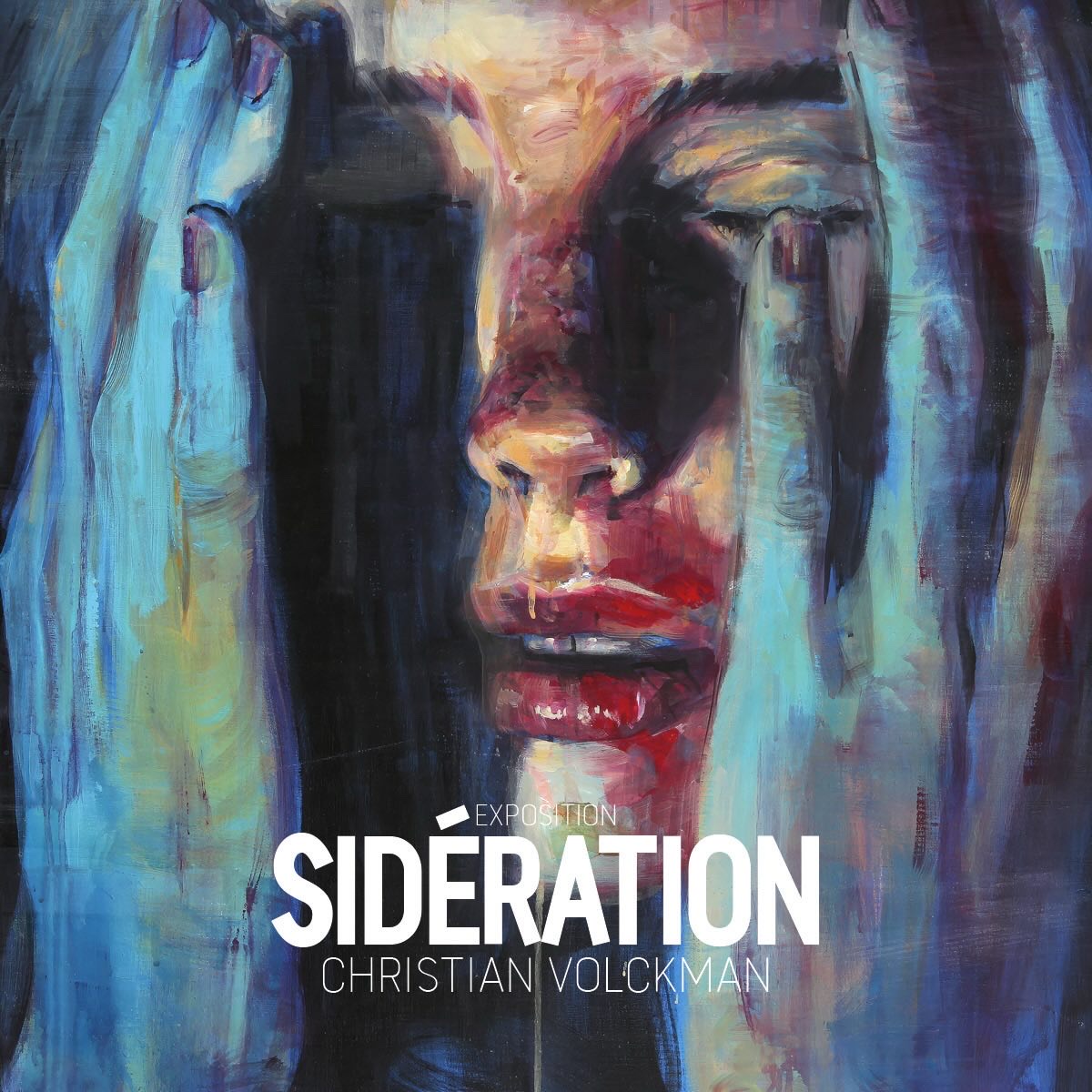
Exhibition 01. Below: the artist's introduction to the exhibition, followed by the paintings.
From cinema to painting, Sidération tracks the suspended instant where consciousness tips — between ecstasy and the loss of self.
The project has its roots in Christian Volckman's childhood. As a boy, he followed his parents around the world in the wake of a thirteen-year-old Indian guru who presented himself as the saviour of humanity, preaching meditation as a path to transcendence. That immersion in a sectarian community lasted more than a decade, and left behind a series of unresolved questions: What is a human being really seeking in mystical experience? Is collective fervour, ecstasy, a sense of transcendence an authentic spiritual experience — or a shared form of delusion? Why the need to hand one's existence over to a charismatic figure claiming privileged access to the truth? And at what point does the search for meaning tip into a kind of self-dispossession?
These questions run through the whole exhibition, sitting at the border between spirituality and psychology: is transcendence an opening onto something beyond the self, or the product of an inner mechanism — a form of self-hypnosis, a chemical response to a reality that has become too complex or too painful to face? Sidération — a state of stunned paralysis — becomes an ambiguous state: at once an intensely focused way of observing reality, and an attempt to escape it.
That flight from reality resonates today with new urgency. In a world saturated with information, crossed by wars, power struggles and successive crises, sidération is no longer tied only to mystical or sectarian experience — it has become a contemporary, almost daily state: the moment when the accumulation of images, narratives and catastrophes exceeds our capacity to think, producing a kind of inner paralysis. We watch, without managing to act. We absorb the world without being able to truly change it.
It is precisely this tipping point that Volckman explores at the heart of the exhibition. The film behind the paintings follows a community withdrawn from the world, led by a charismatic guru — until the day an inexplicable phenomenon strikes during a collective meditation: bodies freeze, as if crossed by a force beyond them. That suspended moment — when the body gives out before the mind can understand — becomes the real subject of the paintings. The artist is less interested in depicting an event than in giving physical presence to that instant of rupture.
Behind these images is also a reflection on the mediums themselves. Cinema and painting embody two opposite relationships to image and reality. Cinema belongs to narrative, to flow, to collective immersion — it captures the gaze and carries the viewer into a shared experience. Painting, by contrast, is slow, solitary, deeply physical. Since the arrival of moving images, it has lost its traditional role of representing the world, and has had to reinvent itself as a space for formal, subjective experimentation.
Painting confronts the artist with constant resistance — of matter, of the body, of time, of failure. In the attempt to bring an image into being, something plays out that often exceeds conscious control. The pictorial gesture oscillates between control and surrender, lucidity and disorientation. In turn, the artist can experience his own form of sidération — no longer religious or collective, but intimate, physical, almost existential.
In this way, painting returns in Sidération not as an alternative to cinema, but as its necessary counterpoint: a space where the image stops narrating and becomes presence — opening an invisible dialogue with the viewer.
Tap the video for sound
Talent Agency — ADEQUAT
Laurent Grégoire & Anne-Sophie Berthelin
